 English
 عربى
عربىHow to Choose the Best Memory Foam Pillow? A Complete Guide 2026
Birth of Memory Foam: From Aerospace Technology to Bedroom Comfort
Memory Foam, chemically known as Polyurethane, was originally developed by NASA in the 1960s to relieve the tremendous pressure astronauts faced during takeoff.
Manufacturing Process
Raw Material Mixing: Mixing polyols, isocyanates, blowing agents, and other chemical substances.
Foaming Reaction: A chemical reaction occurs, generating heat and creating numerous tiny air pores, forming an open-cell structure.
Vacuum Sealing and Curing: The mixture is vacuum-treated in molds to control density, followed by cooling and solidification.
Washing and Cutting: Chemical residues are washed away, and the material is precisely cut into standard sizes.
Memory Foam vs. Latex: Parameter Comparison
The following table displays the technical indicator differences between the two mainstream pillow materials:
| Feature | Memory Foam | Natural Latex |
| Material Source | Petroleum-derived Polyurethane | Rubber tree sap |
| Recovery Speed | Slow rebound (3-10 seconds) | Instant rebound (High elasticity) |
| Breathability | Medium (Depends on open-cell structure) | Excellent (Natural honeycomb pores) |
| Lifespan | 3-5 years | 5-10 years |
| Common Density | 3.0 - 5.5 PCF (lbs/ft³) | 3.5 - 5.0 PCF |
| Odor | Initial off-gassing smell | Faint rubber scent |
| Support Feel | Deep contouring, pressure relief | Resilient support, dynamic response |
How to Choose the Right Pillow?
When choosing a pillow, Loft (Height) and Firmness should be determined based on sleeping position and body type.
Recommended Parameters for Different Sleeping Positions
Side Sleepers: Recommended Height: 12-15 cm (4-6 inches). Firmness Requirement: Medium-firm, to fill the gap between the ear and the shoulder.
Back Sleepers: Recommended Height: 10-12 cm (3-5 inches). Firmness Requirement: Medium, to maintain the natural C-curve of the cervical spine.
Stomach Sleepers: Recommended Height: 5-7 cm (under 3 inches). Firmness Requirement: Extra soft or ultra-thin, to prevent the head from tilting upward excessively.
Density Reference
Low Density (<3 lbs/ft³): Softer touch, slightly faster rebound, average durability.
Medium Density (3-4 lbs/ft³): The most common balanced choice.
High Density (>5 lbs/ft³): Provides stronger support, longer lifespan, and higher temperature sensitivity.
Use and Maintenance of Memory Foam Pillows
Correct Positioning
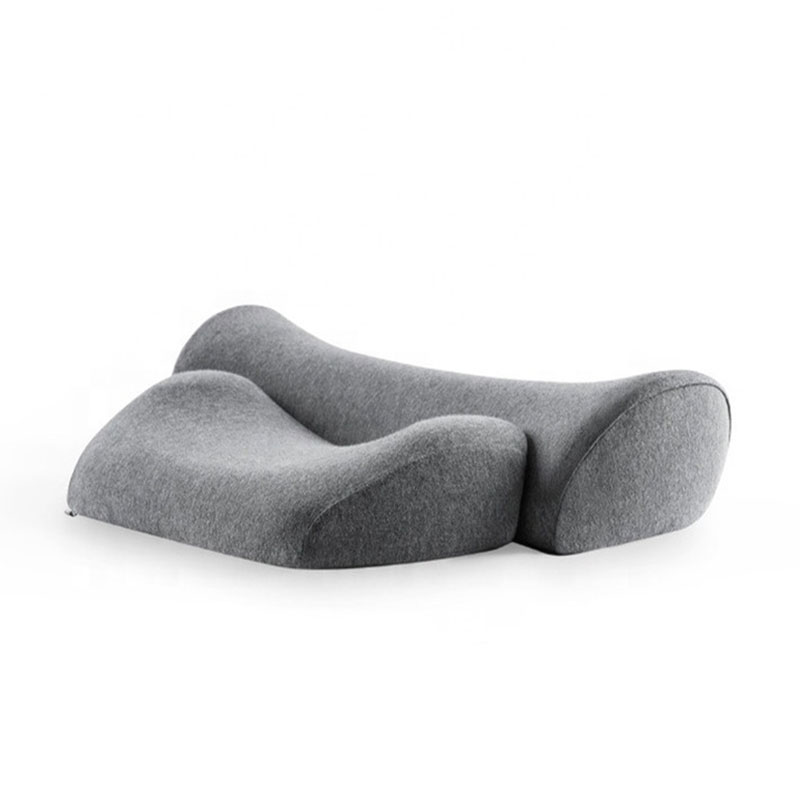
For ergonomic cervical pillows with curves: The Higher Side should be placed against the shoulders to support the neck, while the Lower Side supports the top of the head.
How to Soften a Hard Pillow
Increase Room Temperature: Memory foam is temperature-sensitive. It becomes softer in rooms above 20°C.
Physical Breaking-in: Regularly compress or knead the pillow to make the internal air pores more active.
Cleaning Prohibitions
Strictly No Machine Wash/Dry: Mechanical agitation tears the foam structure, and high heat causes material degradation.
Correct Method: Use warm water and mild detergent for spot cleaning, then air dry in a cool, ventilated place.
Classification and Structural Design
Memory foam pillows come in various shapes and internal constructions, leading to different performance characteristics.
Comparison of Structural Types
| Structure Type | One-Piece Molded | Shredded | Layered |
| Internal Construction | A solid block of high-density foam | Filled with cut pieces of foam | Multiple layers of different densities |
| Height Adjustment | Non-adjustable, fixed height | Highly adjustable by adding/removing fill | Adjustable by swapping layers |
| Breathability | Average (Depends on cells) | Excellent (Large gaps between pieces) | Medium |
| Support Strength | Firm and stable | Soft, high contouring | Adjustable based on combination |
| Ease of Washing | Spot clean core only | Core is often washable | Must disassemble to wash cover |
Functional Parameters of Memory Foam Pillows
These technical parameters directly determine sleep comfort beyond just the shape.
Temperature Sensitivity
Working Principle: When body contact raises the surface temperature to 30°C - 37°C, the molecular structure loosens, allowing it to deform and fit the neck curve.
Environmental Impact: At room temperatures below 15°C, memory foam without special additives will become significantly harder.
Recovery Time
Standard Range: High-quality memory foam recovery time is usually between 3 - 10 seconds.
Performance: Fast Rebound (< 3s) feels more like regular sponge with low contouring, while Slow Rebound (> 10s) provides a slower reaction during tossing and turning, which may cause a temporary "crater" feel.
Odor Level and Off-gassing
VOC Emission: Newly produced polyurethane releases Volatile Organic Compounds (VOCs).
Standard: Quality products should meet low VOC emission standards, ensuring over 95% of odors dissipate within 72 hours.
Body Pillow Manufacturing Parameters and Specifications
If you plan to make or choose a long body pillow, use these standard specifications:
Size Recommendations
Standard: 20 x 54 inches (approx. 50 x 137 cm) — Suitable for most adults.
Extra Long: 20 x 72 inches (approx. 50 x 183 cm) — Suitable for users over 185 cm tall.
Fill Weight Calculation (For Shredded Memory Foam)
Plush/Soft: Approx. 2.5 - 3.0 kg of filling.
Firm Support: Approx. 4.0 - 5.0 kg of filling.
FAQ: User Concerns and Knowledge
Q1: Is the chemical smell of a new pillow harmful?
This off-gassing is the release of gases trapped during production. It usually disappears after 24-48 hours in a ventilated area. Mainstream products certified by standards like CertiPUR-US ensure no harmful substances are present.
Q2: Will a memory foam pillow "collapse"?
High-quality, high-density foam can maintain its shape for over 3 years. If it no longer rebounds or shows permanent sagging, the material has aged and the support has failed, requiring replacement.
Q3: Is it hot to sleep on in summer?
Traditional memory foam retains heat. Modern technology addresses this by adding gel particles or using open-cell foaming techniques to improve heat dissipation.
Q4: Why does memory foam help with neck pain?
It automatically shapes itself based on body heat and pressure, achieving zero pressure feedback, which reduces muscle tension in the neck and keeps the spine in a natural straight line.
Q5: Does memory foam soften over time?
Yes. Long-term pressure and environmental humidity cause cell fatigue, reducing rebound strength. When a pillow fails to return to its original shape after pressing, the molecular structure has failed.
Q6: Are memory foam pillows with gel layers actually useful?
The gel layer primarily increases thermal conductivity. It can lower surface temperature by about 1°C - 2°C during the first 20-30 minutes of sleep. However, without ventilation, the gel eventually reaches equilibrium with body temperature.
Q7: Why are some memory foam pillows very cheap and others very expensive?
The core difference lies in density and formula purity. Cheap products often have densities below 2.5 PCF and use heavy fillers like talcum powder, which causes crumbling, cracking, and unstable rebound performance.
Q8: Can people with allergies use memory foam?
Memory foam is naturally dust mite resistant because its synthetic structure is inhospitable to mites. However, if you are extremely sensitive to chemical odors, ensure thorough ventilation before use.
 previous post